Origin
of the name Şicula
Legends
say that in the old times the village was scattered among the region to avoid
the great floods of the Crişul Alb River. The previous community consisted in
fact of many „cătune”- hamlets- spread on the highest places of the field. The
old men gathered to set a new settlement and decide upon the place and the name
of the new village. One of the chieftains, Cula, by his name, was angry and
late for the meeting. The other ones thought he wouldn’t come at all, but to
everybody’s surprise he showed himself at last. When they saw Cula one of those
local chiefs said: “Iacă şi Cula” (Here‘s Cula, too). Thus they agreed to
call the settlement Şicula. Cula is a short form of the Romanian name Niculae,
Nicolae; there are several people in Romania and Moldova with Cula as a surname
…
The tale of the rivers called Criş
The old men say that, once upon a time, when the men lived together with the giants, there was a
prince of the fields, greedy for gold. He heard of a big gold mine in the
Eastern Mountains, although nobody knew the place, but Criş the Old and his
three sons. The prince had them captured, dungeoned and beaten by his guards to
find out the fortune. The old man died in torture, but he did not reveal the
secret. The lads, scared, decided to tell the place and live so that they could
revenge their father’s death. So they set out for the place where the sun rises
to find the mine, in unsteady steps, followed by the soldiers. After three day
and night’s tiring walk the three lads disagreed on the way to follow, each of
them pointing to another direction. The elder one said they had to keep the
sunrise road, the other two said the right path would be souther. Quick
tempered, the elder brother got angry and started hotfoot where he thought the
way was, escorted by a group of soldiers. The second brother, a light-colored
lad, and the youngest brother, a black one, turned south. Later the youngest brother thought that the
first brother might have been right, so he turned east, too. They wandered many
days and nights in search of the golden mine, escorted by the guards. In the
end the second brother, who went south, came across the treasure in the
mountains. But when he wanted to show it to the soldiers, Vâlva Comorii (=the
female spirit protective of the treasure) came out of the mine and put a spell
on the lad turning him into a rock and the land under his feet into a stream. Vâlva
did the same the other brothers, so that they would never find the treasure.
The soldiers were also turned into springs. Thus the quick tempered brother
became Crişul Repede (the rapid/quick one), the black brother became Crişul Negru
(the black one), the faired-haired brother became Crişul Alb (the white one),
while the guards became the other “Crişuri” (streams with the name Criş), too.
The rocks of the three brothers can still be seen at the springs of the rivers,
if not grounded by winds and rainfall.


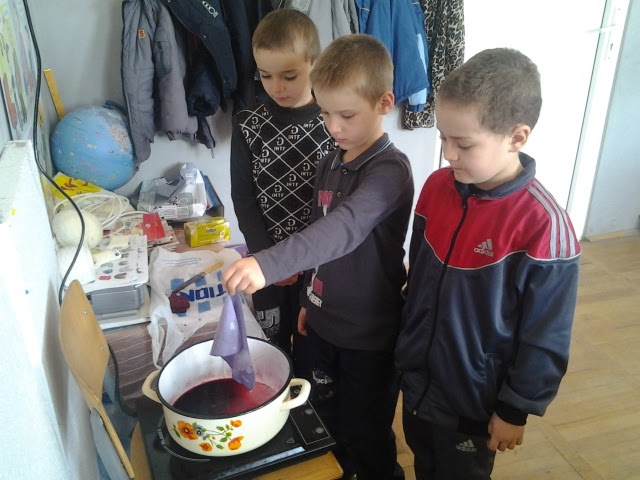


 We separated the flowers, picked and made predictions about which flowers we thought would give off the most color.
 The blue flower gave off a lovely violet color. The blue was a very light blue.


